
Introduction
Customer expectations are changing rapidly. People want quick responses, personalized assistance and convenient ways to resolve their questions. For businesses handling multiple customer enquiries every day, providing consistent support can become challenging.
Traditional customer support systems often depend on manual processes, fixed working hours and large support teams. As customer interactions increase, these limitations can affect response times and overall customer experience.
This is where AI-powered customer support can make a difference.
By combining artificial intelligence, machine learning, natural language processing (NLP) and automation, businesses can create smarter customer support experiences. AI-powered systems can answer frequently asked questions, guide customers through common processes, assist support teams and help businesses understand customer needs.
But implementing AI is not simply about adding a chatbot to a website. Businesses need the right features, integrations and technology to make their customer support systems genuinely useful.
Let's explore the essential features every business should consider when adopting AI-powered customer support.
What Is AI-Powered Customer Support?
AI-powered customer support uses artificial intelligence technologies to help businesses manage customer interactions, respond to enquiries and automate repetitive support activities.
Unlike traditional automated systems that rely entirely on predefined responses, modern AI-powered solutions can understand natural language, identify customer intent and provide relevant information based on available data.
For example, when a customer asks about an order, an AI-powered support assistant can connect with the business's order management system, retrieve relevant information and provide an appropriate response.
These solutions can be implemented across websites, mobile applications, messaging platforms and other digital customer service channels.
Common technologies include:
- Natural Language Processing (NLP): Helps systems understand human language and customer questions.
- Machine Learning: Supports pattern recognition and improves certain predictions using data.
- Generative AI: Helps generate relevant, conversational responses.
- API Integration: Connects AI tools with CRM, ERP, eCommerce and other business systems.
- Automation: Handles repetitive support workflows with minimal manual intervention.
7 Essential Features of AI-Powered Customer Support
1. AI Chatbots for Instant Customer Responses
AI chatbots are among the most widely used features of AI-powered customer support systems. They help businesses respond to common customer questions without requiring a support representative for every interaction.
Modern AI chatbots can understand customer queries and provide relevant responses using natural language processing and knowledge sources.
For example, an eCommerce customer might ask:
- Where is my order?
- What payment methods do you accept?
- Can I return a purchased product?
- How long does delivery take?
An AI chatbot can answer these questions using approved business information and connected systems.
Why businesses need it:
- Provides quick responses to common questions.
- Reduces repetitive support tasks.
- Helps customers find information conveniently.
- Supports customer interactions outside regular business hours.
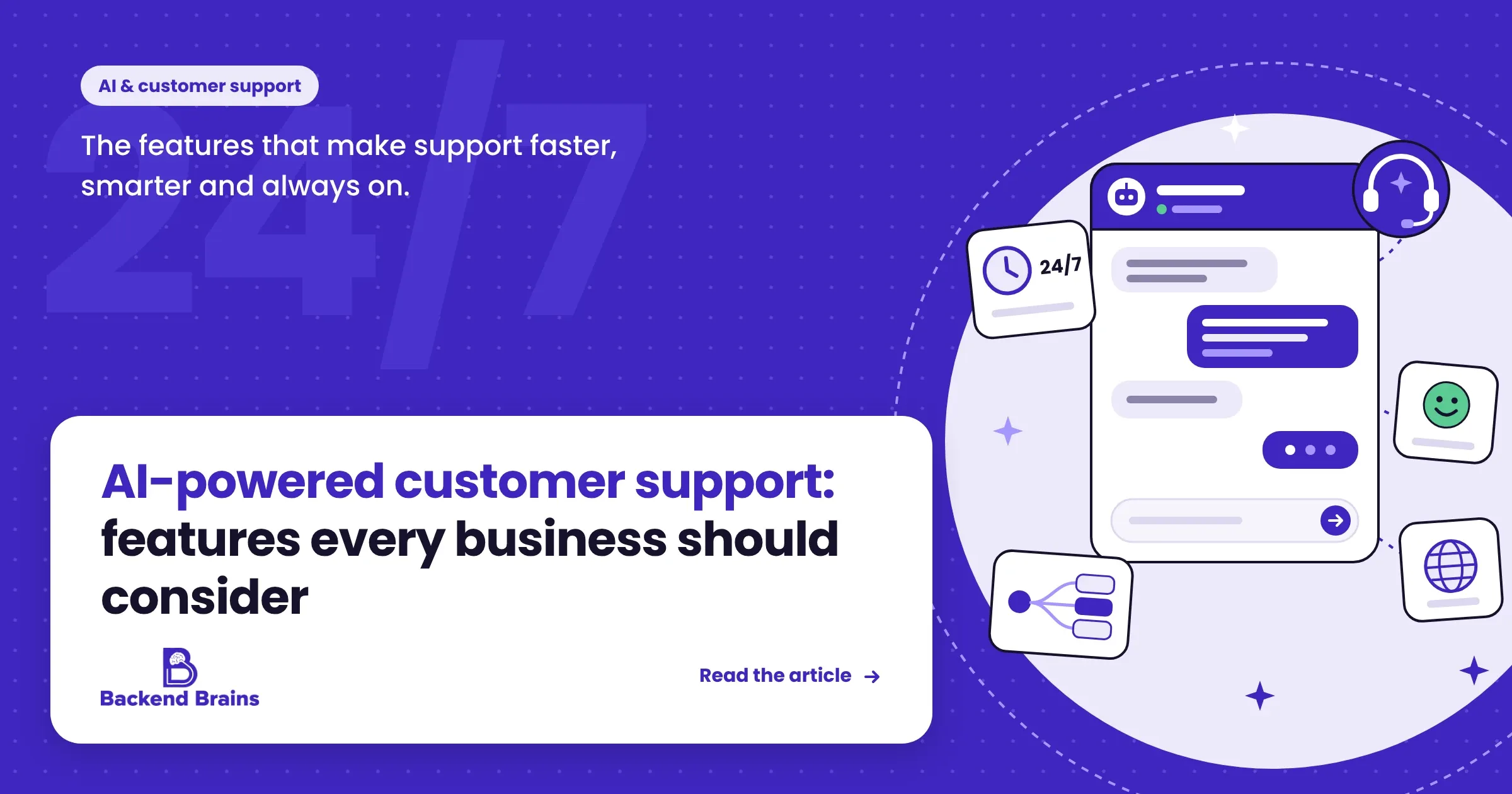
2. 24/7 Customer Assistance
Customers may visit a website or use a mobile application at any time. However, businesses cannot always maintain human support teams around the clock.
AI-powered customer support can provide automated assistance beyond regular working hours.
For example, a customer visiting a software company's website late at night might want to understand pricing, available services or product features. An AI assistant can answer questions using the company's approved information and guide the visitor towards the appropriate next step.
Why businesses need it:
- Provides assistance beyond business hours.
- Helps international customers across different time zones.
- Reduces delays for routine enquiries.
- Creates more convenient customer experiences.
It is important to remember that 24/7 AI availability does not mean every issue can be resolved automatically. Complex enquiries may still require human support.
3. Personalized Customer Interactions
Every customer has different requirements, preferences and expectations. Providing the same response to every customer may not always create a useful experience.
AI-powered customer support can use relevant customer information and interaction history to deliver more contextual assistance.
For example, an online shopping platform can use available purchase history and customer preferences to recommend relevant products or help customers find suitable alternatives.
Similarly, a service-based business can use previous enquiry details to provide more relevant assistance when a customer returns.
Why businesses need it:
- Makes interactions more relevant.
- Helps identify customer preferences.
- Supports personalized recommendations.
- Creates more consistent customer experiences.
Businesses should use customer information responsibly, with appropriate permissions, privacy controls and data protection measures.
4. CRM and Third-Party API Integration
An AI customer support system becomes more useful when it can connect with existing business applications.
Without integration, a chatbot may only provide general information. With appropriate API integrations, it can access authorized information from connected systems and support more specific customer requests.
For example, businesses can connect AI support solutions with:
- CRM platforms to retrieve customer records.
- eCommerce systems to access order information.
- Payment platforms to check transaction status.
- Booking systems to retrieve appointment details.
- Helpdesk software to manage support tickets.
Imagine a customer asking about an existing service request. An integrated AI assistant can retrieve the relevant ticket information and provide an update, subject to the customer's authorization.
Why businesses need it:
- Connects different business applications.
- Reduces repetitive manual data entry.
- Improves information accessibility.
- Supports more connected workflows.
This is where custom API development and integration play an important role.
5. Multilingual Customer Support
Businesses serving international markets need to communicate with customers who speak different languages.
AI-powered customer support can help businesses provide multilingual assistance through language detection, translation and multilingual conversational models.
For example, a company serving customers in the USA, UK and Germany may need to support English- and German-speaking customers.
An AI assistant with suitable multilingual capabilities can help customers communicate in their preferred supported language.
Why businesses need it:
- Supports international customer interactions.
- Reduces language-related communication barriers.
- Helps businesses serve different markets.
- Creates more accessible digital experiences.
Businesses should test translation accuracy, particularly when dealing with technical, legal or sensitive customer enquiries.
6. Smart Ticket Management and Query Classification
Not every customer enquiry requires the same level of attention.
Some customers may need basic product information, while others may have payment issues, technical problems or urgent service requests.
AI-powered ticket management can classify incoming enquiries based on their content, identify relevant categories and help route requests to the appropriate support teams.
For example:
|
Customer Enquiry |
Suggested Category |
|
Payment unsuccessful |
Billing |
|
Website not loading |
Technical support |
|
Product information |
General enquiry |
|
Refund request |
Returns and refunds |
|
Account access issue |
Account support |
Why businesses need it:
- Organizes incoming customer enquiries.
- Helps prioritize important requests.
- Supports efficient ticket routing.
- Makes support workflows easier to manage.
7. Human Support Escalation
AI automation should not replace human support in every situation.
Some customer issues require professional judgment, personal attention or access to information that an AI system should not independently handle.
A well-designed AI customer support solution should recognize when a query needs human intervention.
For example, if a customer reports a complicated billing issue or remains dissatisfied after automated assistance, the system can transfer the conversation to a support representative along with relevant conversation context.
Why businesses need it:
- Provides human assistance for complex issues.
- Prevents customers from getting stuck in automated conversations.
- Helps support teams understand previous interactions.
- Creates a balance between automation and human expertise.
8. Benefits of AI-Powered Customer Support for Businesses
Implementing AI in customer support can offer several operational and customer experience benefits.
Faster Response Times
AI assistants can respond to supported customer questions without requiring a representative to manually handle every interaction.
Improved Operational Efficiency
Automating repetitive activities allows support teams to spend more time addressing complex customer requirements.
Consistent Customer Communication
AI assistants can use approved knowledge sources and response guidelines to provide more consistent information.
Better Customer Insights
AI-powered analytics can help businesses identify recurring questions, common customer concerns and patterns in support interactions.
Support for Business Growth
As enquiry volumes increase, AI can help manage routine interactions while human support teams focus on more complicated requests.
However, actual results depend on implementation quality, integration capabilities, data accuracy and customer adoption.
9. How to Implement AI-Powered Customer Support
Introducing AI into customer support requires more than selecting a chatbot platform. Businesses should first understand their customer service requirements and existing workflows.
Here are some important steps to consider.
Step 1: Identify Customer Support Challenges
Understand the most common customer enquiries, repetitive tasks and areas where customers experience delays.
Step 2: Choose the Right AI Technology
Depending on business requirements, consider AI chatbots, conversational AI, generative AI or workflow automation.
Step 3: Prepare Reliable Knowledge Sources
Organize FAQs, product information, service details, policies and other approved business information. This helps the AI system provide relevant responses.
Step 4: Integrate Existing Business Systems
Connect the AI solution with relevant CRM platforms, websites, mobile applications, helpdesk systems and other business tools through APIs.
Step 5: Establish Security and Access Controls
Implement appropriate authentication, data access permissions, privacy controls and safeguards for sensitive customer information.
Step 6: Test Before Deployment
Test different customer questions, unusual requests, incorrect inputs and escalation scenarios before making the system available to customers.
Step 7: Monitor and Improve Performance
Review response accuracy, customer feedback, escalation rates and unresolved queries. Regularly update the knowledge sources and workflows.
10. Industries That Can Benefit from AI Customer Support
AI-powered customer support is useful across several industries.
|
Industry |
Potential AI Application |
|
eCommerce |
Order tracking, product enquiries and returns assistance |
|
Healthcare |
Appointment information and administrative enquiries |
|
Banking & Finance |
General account information and service enquiries |
|
Education |
Course information and student assistance |
|
Real Estate |
Property enquiries and appointment scheduling |
|
Travel & Hospitality |
Booking assistance and reservation information |
|
SaaS & Technology |
Product guidance and technical support |
Each industry has different requirements. For example, healthcare and financial services need particularly careful handling of sensitive information and regulatory obligations.
11. Challenges Businesses Should Consider Before Adopting AI
Although AI can improve customer support operations, businesses should also understand its limitations.
Incorrect or Incomplete Responses
AI systems may generate inaccurate information. Businesses should use reliable knowledge sources and appropriate response safeguards.
Data Privacy Concerns
Customer information must be handled according to applicable privacy laws and security requirements.
Integration Complexity
Connecting AI systems with older or customized software may require additional development and testing.
Lack of Human Understanding
AI may struggle with emotionally sensitive or unusual customer situations.
Ongoing Maintenance
AI support systems require regular monitoring, knowledge updates, security reviews and performance improvements.
The right implementation approach should combine AI automation with human supervision and clear escalation processes.
12. AI-Powered Customer Support: What's Next?
AI-powered customer support is moving beyond basic question-and-answer chatbots.
Businesses are increasingly exploring conversational AI, AI agents, automated workflows and intelligent integrations to support more complex customer service processes.
Future solutions may include:
- AI agents that coordinate multiple business workflows.
- Voice-based AI assistants for customer interactions.
- More contextual and personalized customer experiences.
- Predictive insights to identify potential customer issues.
- Deeper integrations across business applications.
The goal is not simply to automate every customer interaction. It is to make customer support more accessible, efficient and responsive while keeping human assistance available when needed.
Making AI Work for Your Business
AI-powered customer support is becoming an important part of modern business operations. From intelligent chatbots and personalized interactions to API integrations and automated ticket management, AI offers several ways to improve how businesses communicate with their customers.
However, successful implementation depends on choosing the right technology, understanding customer requirements and connecting AI solutions with existing business systems.
Businesses should focus on creating a customer support experience that combines automation, reliable information and human assistance.
At Backend Brains, we help businesses explore AI-powered solutions, chatbot development, custom software development and API integrations designed around their operational needs.
Whether you want to automate customer enquiries, integrate AI into an existing platform or develop a custom AI-powered support solution, the right technology can help your business move forward.
Ready to make your customer support smarter? Connect with Backend Brains to explore AI development and integration solutions.
Share This Article