
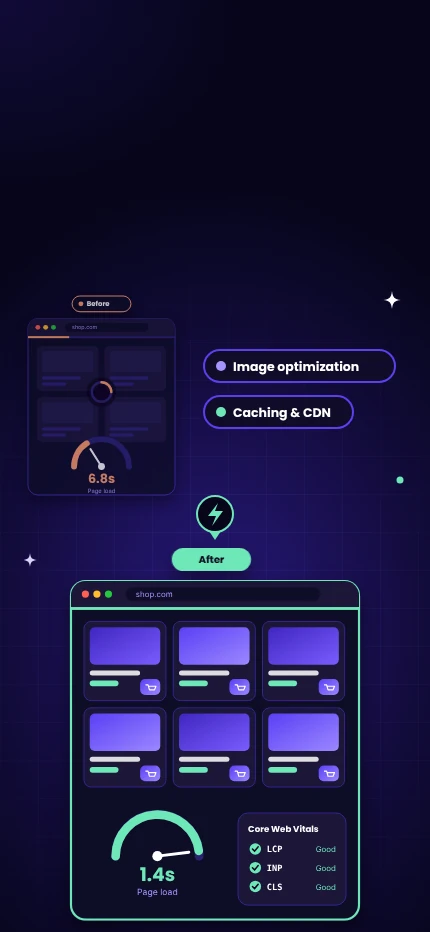
The challenge
Performance was affecting the whole shopping journey. The site was dealing with:
- Slow-loading product and category pages
- Large product images adding page weight
- Too many third-party scripts
- Unoptimized JavaScript and CSS
- A poor mobile browsing experience
- Delays when moving between products
- Slowdowns during high-traffic periods
The objective
The goal was not only a faster website. It was a smoother, more conversion-friendly shopping experience that kept every existing feature working.
- Improve page-loading performance
- Optimize the mobile experience
- Reduce unnecessary browser processing
- Make product pages more responsive
- Optimize images and other assets
- Create a more reliable shopping journey
- Set up better performance monitoring
What we measured against
Each metric is judged at the 75th percentile of real page visits. The audit started here.
Our approach
-
Performance audit
We analyzed the site to find the main bottlenecks, then prioritized fixes by their impact on the customer journey.
- Core Web Vitals
- Page-loading behavior
- JavaScript execution
- Image sizes
- CSS delivery
- Server response time
- Third-party scripts
- Mobile performance
- Product and category pages
-
Image optimization
Product imagery drives eCommerce, and large images add a lot of page weight. We kept visual quality while cutting unnecessary data transfer.
- Compressed large images
- Served correctly sized images
- Modern formats where suitable
- Lazy-loaded off-screen images
- Prioritized above-the-fold images
-
JavaScript optimization
The site loaded scripts it didn't need right away. We reworked the loading strategy so there was less work before shoppers could interact.
- Removed unnecessary scripts
- Reduced render-blocking resources
- Deferred non-critical JavaScript
- Split large bundles
- Loaded features on demand
-
Product and category pages
These pages carry the journey, so we made essential content available as quickly as possible for a more fluid browsing experience.
- Prioritized key product content
- Faster image loading
- Leaner product data delivery
- Fewer unnecessary elements
- Smoother category-to-product navigation
-
Mobile experience
Many shoppers browse on phones, so mobile got special attention. The aim was a consistent experience across devices and network conditions.
- Responsive layouts
- Image delivery
- Touch interactions
- Navigation
- Product browsing
- Page weight
- Mobile rendering
-
Caching and delivery
We reviewed how frequently used resources reach returning visitors, to cut repeated work and improve response times.
- Browser caching
- Server-side caching
- CDN configuration
- Static asset optimization
- Efficient resource delivery
Technology
| Frontend | React, JavaScript, HTML, CSS |
|---|---|
| Backend | Laravel, Node.js, PHP |
| Database | MySQL, PostgreSQL |
| Performance | Core Web Vitals, Lighthouse |
| Infrastructure | Cloud, CDN, caching |
The outcome
Faster page loading
Essential content appears sooner, so shoppers wait less.
Smoother product discovery
Moving between categories and products is quicker.
Better mobile experience
The journey is more responsive on phones.
Leaner technical footprint
Fewer unnecessary resources make the site more efficient.
Stronger conversion potential
A faster, easier journey gives shoppers fewer reasons to leave.
Why performance matters
Website speed is more than a technical metric. It shapes how customers experience a brand and move through the funnel. Published case studies from Google back this up:
Source: Google case studies on web.dev.
Key takeaway
Performance work isn't about a perfect speed score. It's about removing friction, so a slow digital storefront becomes a smoother place to shop.
At Backend Brains, performance-focused web development combines UX, modern development practices, cloud technologies and ongoing optimization.
