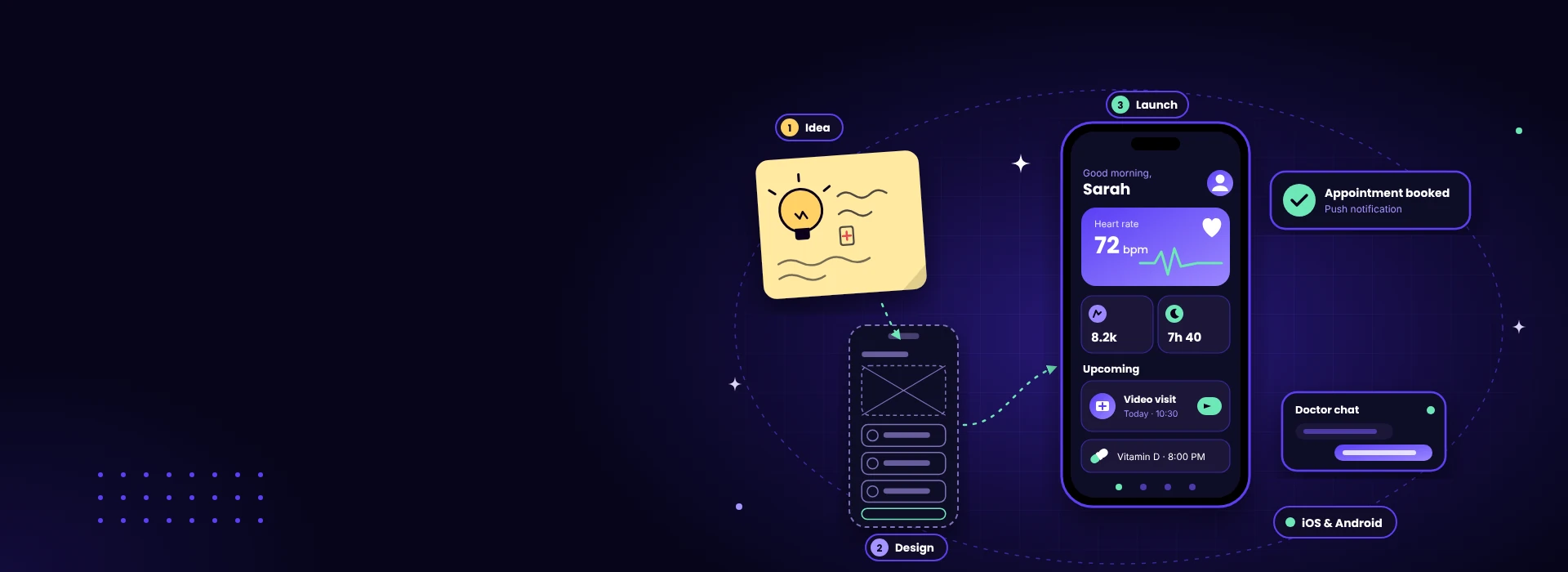
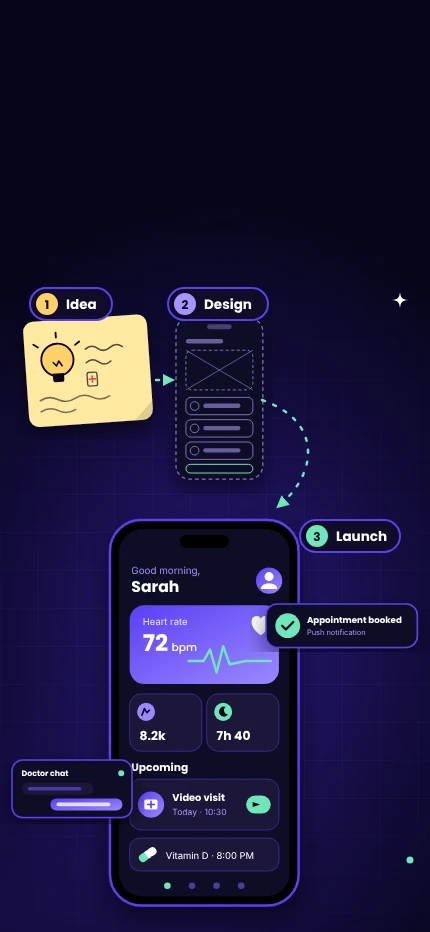
The challenge
The job wasn't only building an app. An early-stage idea had to become a practical, intuitive and scalable product, simple enough for people with any level of digital experience.
- Turn the business idea into clear features
- Create a simple experience for patients
- Support both iOS and Android
- Design secure user authentication
- Manage appointments digitally
- Connect patients and professionals
- Build a backend ready for growth
Where we started
We mapped how a patient moves through the product first, and turned that into the product roadmap.
- Discover Find a service that fits their need
- Register Create an account in a few steps
- Choose Review healthcare professional profiles
- Book Schedule an appointment in minimal steps
- Stay informed Get confirmations and updates
Our approach
-
Product discovery
We worked through the core business requirements and defined the first version. The MVP focused on essential functionality, not extra complexity.
-
UI/UX design
The interface was designed around simplicity and accessibility.
- Clear navigation
- Simple onboarding
- Easy appointment discovery
- Minimal booking steps
- Clear notifications
- Accessible information architecture
- Consistent across devices
-
Mobile app development
A cross-platform build let the startup serve iOS and Android users from one shared codebase, with Flutter or React Native as the foundation.
-
Backend and API development
Backend services power the app, and a modular API architecture leaves room for future integrations.
- User accounts
- Appointment management
- Professional profiles
- Notifications
- Data management
- API communication
- Admin controls
-
Security-focused architecture
Healthcare apps need particular care with privacy. Exact regulatory requirements depend on the market and the type of health data involved.
- Secure authentication
- Role-based access
- Protected APIs
- Encrypted communication
- Controlled access to sensitive data
- Secure data storage
Key features
Patient registration
A streamlined onboarding flow to create and manage accounts.
Appointment management
Find services and manage bookings without phone calls back and forth.
Professional profiles
Review a professional's details before choosing an appointment.
Notifications
Automatic reminders, confirmations and important updates.
Admin dashboard
One place for the team to manage users, appointments and activity.
Scalable API layer
New features and integrations without a technical overhaul.
From MVP to growth
- Registration and onboarding
- Appointment booking
- Professional profiles
- Notifications
- Admin dashboard
- Teleconsultation
- Digital prescriptions
- Secure messaging
- Health records
- Payment integration
- AI-powered assistance
- Personalized health content
- Third-party healthcare integrations
Technology
| Mobile | Flutter, React Native |
|---|---|
| Backend | Node.js, Laravel |
| APIs | REST APIs |
| Database | PostgreSQL, MySQL |
| Cloud | AWS, Google Cloud |
| Notifications | Firebase |
| Security | Authentication, encryption, role-based access |
The outcome
A clear patient journey
Essential healthcare interactions are easier to get through.
Mobile-first experience
Designed around how patients use services on their phones.
A scalable foundation
The architecture supports new features as the startup grows.
Operational efficiency
Digital workflows cut repetitive manual coordination.
Room to innovate
A path toward telehealth and AI-assisted services.
Key takeaway
A great healthcare app starts with a clear understanding of patients, not a list of features.
Product strategy, UI/UX, mobile development, backend engineering and a scalable architecture together turn an early idea into a product ready for real-world growth.
