
A website can attract thousands of visitors and still generate very few leads.
Why?
Because getting visitors is only the first step. A successful business website needs to guide those visitors from discovering your brand to trusting your business and finally taking action.
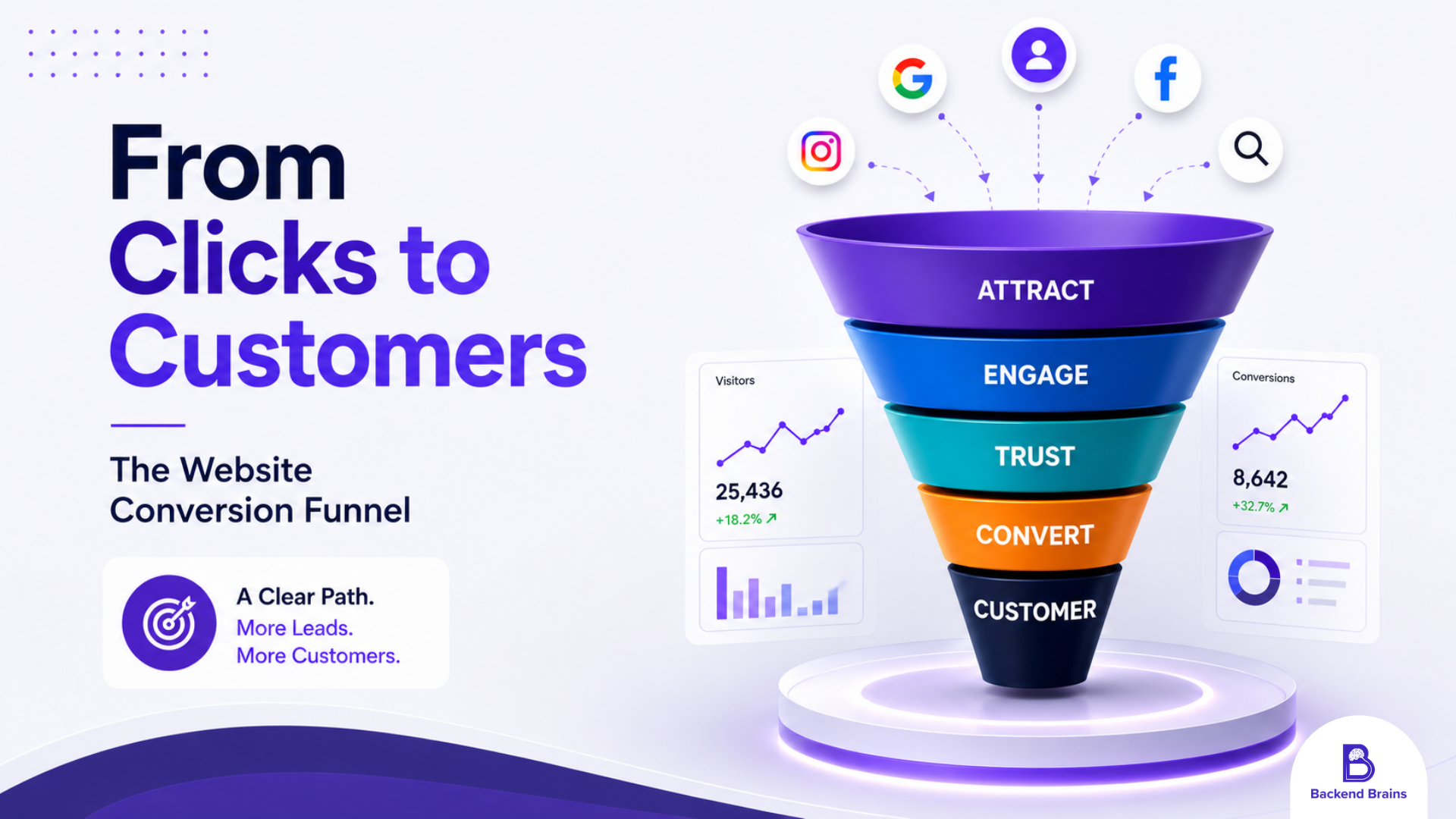
That journey is called a website conversion funnel.
A well-designed conversion funnel combines website design, user experience, content, trust signals, calls-to-action, and a clear customer journey to turn visitors into qualified leads and, eventually, customers.
In this guide, we'll explain how to build an effective website conversion funnel and what businesses should focus on at every stage.
What Is a Website Conversion Funnel?
A website conversion funnel represents the steps a visitor takes before becoming a lead or customer.
A typical funnel looks like this:
Visitor → Interested Visitor → Engaged Visitor → Lead → Customer
Not every visitor will become a customer immediately. Some may be discovering your business for the first time, while others may already be comparing different providers.
Your website should therefore provide the right information and action at each stage.
The 5 Stages of a Website Conversion Funnel
1. Attract the Right Visitors
The funnel starts before someone even visits your website.
Your goal isn't simply to get more traffic. You need to attract the right traffic.
Visitors can come from:
- Google search
- Social media
- Paid advertising
- Referral websites
- Online directories
- Email marketing
- AI and search platforms
- Direct searches for your brand
Your content and SEO strategy should target the problems, questions, and services your potential customers are actually searching for.
For example, a business looking for a web development company may search for:
- Custom web development
- Website redesign services
- B2B website development
- E-commerce development
- Web Development Company
The more relevant your traffic, the greater your chances of generating qualified leads.
2. Capture Attention Quickly
Once visitors land on your website, you have a limited opportunity to convince them to stay.
Your homepage or landing page should immediately answer three questions:
What do you offer?
Who is it for?
Why should visitors choose you?
Your headline should be clear rather than overly complicated.
Instead of a vague headline such as:
"Transforming Ideas Into Digital Experiences"
A more direct message could be:
Custom Websites That Help Businesses Generate More Leads
The second message tells visitors what you do and the potential benefit.
Your above-the-fold section should ideally include:
- A clear headline
- Short supporting text
- A strong CTA
- Relevant visual content
- Trust indicators
Don't make visitors search for basic information about your business.
3. Build Trust Before Asking for Action
Visitors rarely become customers simply because you have a good-looking website.
They need a reason to trust you.
This is especially important for services such as web development, software development, consulting, marketing, and other B2B services where customers may be making a significant investment.
Add trust-building elements such as:
- Client testimonials
- Case studies
- Portfolio projects
- Client logos
- Certifications
- Industry experience
- Awards or recognitions
- Results and measurable outcomes
- Clear company information
For example, instead of simply saying:
"We build high-quality websites."
Show visitors:
"Here are some websites we've built and the business problems they solved."
Evidence is generally more persuasive than claims.
4. Make Taking Action Easy
Once visitors understand your offering and trust your business, they need a simple way to take the next step.
This is where your call-to-action (CTA) becomes important.
Examples include:
- Get a Free Consultation
- Request a Quote
- Schedule a Call
- Start Your Project
- Talk to an Expert
- Get a Website Audit
Your CTA should be visible and relevant to the page.
Don't make visitors scroll through multiple sections just to find a contact button.
Avoid CTA overload
Having too many competing CTAs can create confusion.
For example, placing:
Buy Now | Learn More | Contact Us | Download | Subscribe | Book a Call | Get Started
all in the same section can make it difficult for visitors to decide what to do.
Choose a primary action based on the purpose of the page.
5. Turn Leads Into Customers
Getting a form submission doesn't automatically mean you've won a customer.
The next stage is lead nurturing.
Once someone contacts your business, the experience should remain smooth.
Your lead-management process might include:
- Visitor submits an inquiry.
- The business receives the lead.
- The lead receives a confirmation.
- A team member follows up.
- The customer's requirements are discussed.
- A proposal or estimate is prepared.
- Questions and concerns are addressed.
- The project moves toward conversion.
Your website and your sales process should work together.
A great website can generate leads, but a poor follow-up process can still result in lost opportunities.
Key Website Elements That Support Conversion
A conversion-focused website isn't about adding more elements. It's about using the right elements in the right places.
Clear Navigation
Visitors should quickly understand where to find:
- Services
- About
- Portfolio
- Case studies
- Blog
- Contact information
Complicated navigation can increase friction.
Strong Landing Pages
If you're running an advertising or SEO campaign for a particular service, send visitors to a relevant landing page instead of always sending them to the homepage.
A focused landing page can have:
- One clear objective
- Relevant messaging
- Benefits
- Trust signals
- FAQs
- Strong CTA
Mobile-Friendly Design
A significant portion of website traffic comes from mobile devices.
Your website should be easy to navigate and use on smaller screens.
Check:
- Text readability
- Button size
- Navigation
- Form usability
- Page loading
- Image scaling
- Spacing
A website that works well on desktop but frustrates mobile users can lose potential leads.
Website Speed
Slow websites can negatively affect user experience.
Optimize:
- Images
- Code
- Scripts
- Fonts
- Third-party integrations
- Caching
- Hosting configuration
A faster website creates a smoother experience and removes unnecessary friction.
Common Website Conversion Funnel Mistakes
Many businesses invest heavily in website design but overlook conversion strategy.
Here are some common mistakes.
1. Focusing Only on Design
A visually attractive website is useful, but design alone doesn't generate leads.
The website also needs clear messaging, good UX, relevant content, trust signals, and CTAs.
2. Using Generic Messaging
Visitors should quickly understand what makes your business relevant to them.
Generic statements don't communicate a strong reason to continue exploring.
3. Hiding Contact Options
If visitors are ready to talk but can't easily find your contact information, you may lose the opportunity.
4. Asking for Too Much Information
Long forms can discourage visitors.
Only ask for the information you actually need at the initial stage.
5. No Social Proof
Visitors may hesitate to contact a business if they can't find evidence that others have successfully worked with it.
6. Ignoring Existing Traffic
Some businesses constantly focus on getting more visitors while ignoring the visitors they already have.
Before spending more money on traffic, analyze whether your current website is converting effectively.
How to Measure Your Website Conversion Funnel
You can't improve what you don't measure.
Important metrics include:
Traffic
How many people are visiting your website?
Engagement
Are visitors actually exploring your pages?
Bounce or Engagement Signals
Are visitors leaving quickly, or are they engaging with your content?
CTA Clicks
How many visitors click important buttons?
Form Submissions
How many visitors become leads?
Conversion Rate
What percentage of visitors complete your desired action?
A simple conversion-rate calculation is:
Conversion Rate = (Conversions ÷ Total Visitors) × 100
For example, if 1,000 visitors generate 30 inquiries:
30 ÷ 1,000 × 100 = 3% conversion rate
The exact conversion rate you should aim for depends on your industry, traffic source, offer, audience, and business model.
How to Improve Your Website Conversion Funnel
If your website receives traffic but generates few leads, don't immediately assume you need a completely new website.
Start by identifying where visitors are dropping off.
Ask:
- Are visitors finding the right pages?
- Is the value proposition clear?
- Are important CTAs easy to find?
- Does the website build enough trust?
- Are forms simple?
- Is the website mobile-friendly?
- Are pages loading quickly?
- Does each service page have a clear next step?
- Are visitors getting the information they need before contacting you?
Small improvements can sometimes make a meaningful difference.
For example, improving a headline, simplifying a form, adding relevant case studies, or making a CTA more visible can reduce friction in the customer journey.
Your Website Should Guide, Not Just Inform
A business website shouldn't function like an online brochure that simply lists your services.
It should guide visitors.
Attract → Explain → Build Trust → Engage → Convert → Nurture
Every page should have a purpose.
Your homepage may introduce your business.
Your service pages explain what you offer.
Your case studies demonstrate your capabilities.
Your blog answers questions and attracts search traffic.
Your landing pages focus on specific campaigns.
Your contact page makes the next step easy.
When these elements work together, your website becomes a conversion system, not just a digital presence.
The Bottom Line
Getting visitors to your website is only the beginning.
The real opportunity is turning those visitors into meaningful business opportunities.
A successful website conversion funnel combines SEO, content, UX, design, trust, clear messaging, strong CTAs, and an effective follow-up process.
Instead of asking:
"How can we get more website traffic?"
Businesses should also ask:
"How can we help more of our existing visitors take the next step?"
Because more traffic isn't always the answer.
Sometimes, the biggest growth opportunity is already sitting on your website.
Need a website that is designed to attract, engage, and convert? Backend Brains can help you build a conversion-focused digital experience tailored to your business goals.
Share This Article